


REFERENCE CONTENTS
Cleanroom and engineering insights from ASTI — practical answers on cleanroom design, classification, contamination control and construction, informed by industry knowledge and project experience.


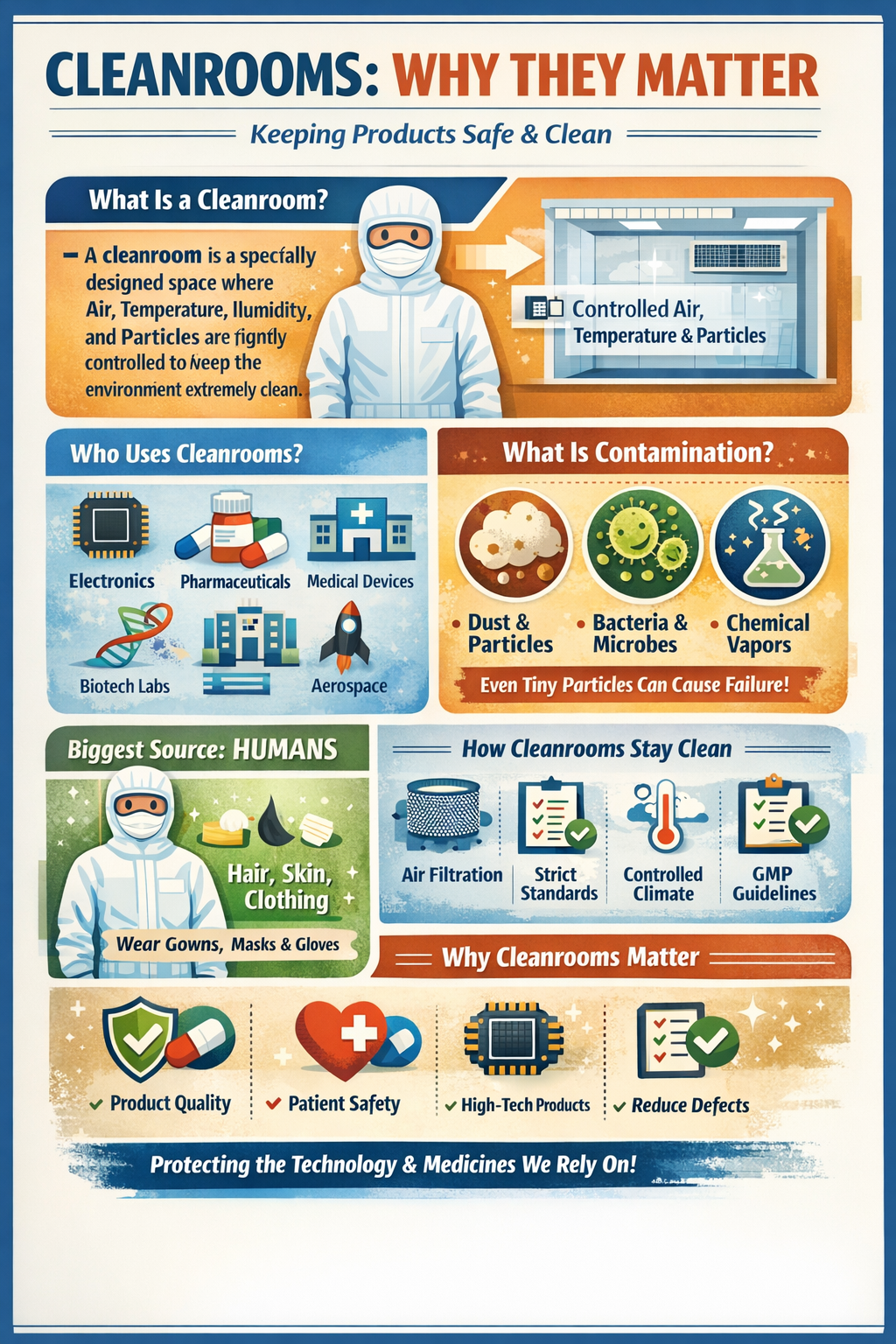
A cleanroom is a controlled environment in industrial and manufacturing settings where airborne particles, contaminants, and environmental conditions such as temperature, humidity, and pressure are strictly regulated to meet precise operational standards. Used primarily in industries like semiconductor fabrication, pharmaceuticals, biotechnology, and aerospace, cleanrooms prevent contamination-sensitive processes from defects or failures. These environments leverage HEPA/ULPA filtration, airflow control, and strict personnel protocols to ensure product integrity and regulatory compliance.
Learn more about ASTI’s cleanroom construction services
A sub-fab is the support level located directly beneath a semiconductor cleanroom. It houses the storage tanks, chemical and gas distribution systems, and handling infrastructure that feed the cleanroom above. Because it manages hazardous chemicals, the sub-fab is built with dedicated safety and containment systems.
Learn more about ASTI’s cleanroom construction services
Industry reference: Cleanroom Technology, Vol. 32
Designing and constructing a sub-fab requires careful coordination of multiple systems so it reliably supports the cleanroom above. Key considerations include chemical and gas delivery, ultra-pure water supply, waste management, structural loading and the routing of utilities — all planned to keep the cleanroom running without interruption.
Learn more about ASTI’s cleanroom construction services
Industry reference: Cleanroom Technology Vol. 32
Contamination control is the central challenge in a sub-fab. Even minor contamination can travel into the cleanroom above, causing yield losses and reduced device performance in semiconductor manufacturing. Maintaining cleanliness, containment and system reliability in the sub-fab is therefore critical to overall fab output.
Learn more about ASTI’s cleanroom construction services
Industry reference: Cleanroom Technology Vol. 32
Cleanrooms and cleanroom sub-fabs are high technology facilities that involve interdependent complex systems. Hence, contractors constructing cleanroom sub-fabs need extensive installation experience with HVAC systems, chemical and gas distribution systems, UPW and waste management systems.
Learn more about ASTI’s cleanroom construction services
Industry reference: Cleanroom Technology Vol. 32
Computational Fluid Dynamics (CFD) modelling is widely used to optimise cleanroom design and operation. It helps engineers predict and improve airflow, temperature distribution and particle transport before construction — reducing contamination risk and supporting more efficient, better-performing cleanroom environments.
Learn more about ASTI’s cleanroom construction services
Industry reference: Cleanroom Technology Vol. 32
An effective fab layout optimises how materials and personnel move through the facility. Good layout planning reduces the risk of cross-contamination, minimises unnecessary handling and movement, and increases overall productivity — making it a key factor in semiconductor plant design.
Learn more about ASTI’s cleanroom construction services
Industry reference: https://cleanroomtechnology.com/semiconductor-fab-design-what-do-you-have-to
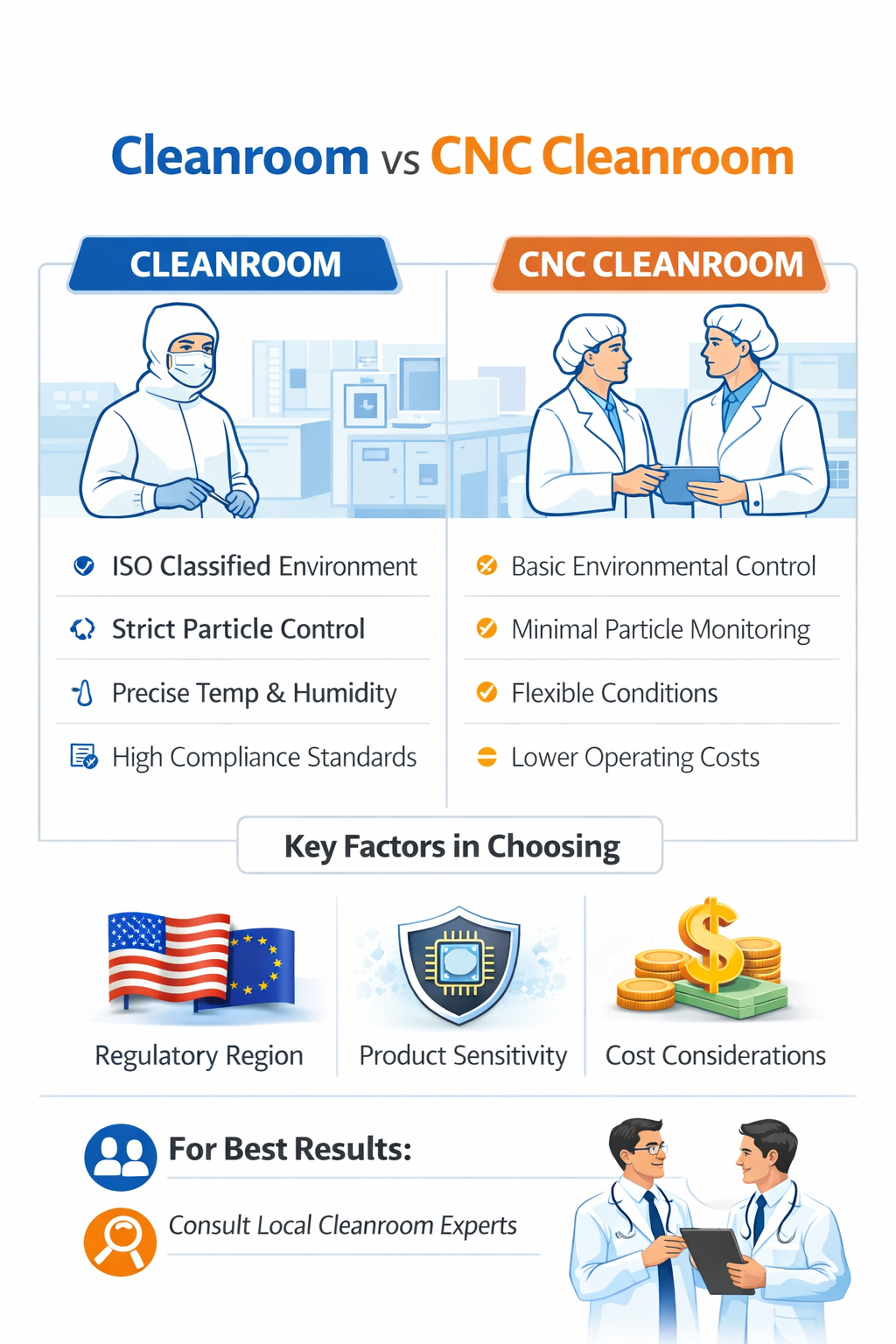
Cleanroom vs Controlled Non-classified (CNC) Cleanroom: Key Differences Explained
A cleanroom is a tightly controlled environment with strict, classified limits on airborne particles, temperature and humidity, usually certified to ISO 14644 standards. A Controlled Non-Classified (CNC) cleanroom provides basic environmental control but is not held to formal classification limits. The right choice depends on the product’s sensitivity, regulatory requirements and budget — classified cleanrooms suit critical processes, while CNC spaces suit lower-risk applications.
ASTI builds ISO-classified cleanrooms — see our cleanroom construction services.
ISO Cleanroom Classifications Explained: Understanding ISO 14644-1 Standards
ISO 14644-1 classifies cleanrooms by the concentration of airborne particles allowed in the air. Classes range from ISO Class 1, the most stringent, to ISO Class 9, the least. The standard gives industries such as semiconductor, pharmaceutical and biotechnology a consistent benchmark for cleanliness, helping facilities maintain product quality, meet regulatory requirements and demonstrate compliance.
ASTI builds ISO-classified cleanrooms — see our cleanroom construction services.
Cleanroom vs. Laminar Flow Hood: Key Differences and Applications
A cleanroom is a controlled room-scale environment that manages airborne particles, temperature and humidity across the whole space. A laminar flow hood provides particle-free air over a single, localized workspace. Cleanrooms suit large-scale manufacturing where the entire environment must be controlled; laminar flow hoods suit specific laboratory tasks such as sample preparation. The right option depends on whether contamination control is needed room-wide or only at a workstation.
Learn more about ASTI’s cleanroom construction services
HEPA vs. ULPA Filters in Cleanrooms: Which Is Better for Contamination Control?
HEPA (High-Efficiency Particulate Air) filters capture 99.97% of particles 0.3 microns and larger, and are suitable for most pharmaceutical, biotech and electronics cleanrooms. ULPA (Ultra-Low Penetration Air) filters capture 99.999% of particles down to 0.12 microns, suiting the strictest environments such as semiconductor manufacturing. ULPA offers higher filtration but at greater cost and maintenance. The choice depends on the cleanliness class the facility must achieve.
Learn more about ASTI’s cleanroom construction services
How Cleanroom Garments Prevent Particle Contamination: Best Practices
Personnel are a leading source of cleanroom contamination, releasing particles and fibres. Cleanroom garments — coveralls, hoods, gloves and shoe covers — are designed to contain these and keep them out of the controlled environment. Effective use depends on correct gowning procedures, regular garment inspection and strict laundering protocols, all aligned with ISO and GMP requirements.
Learn more about ASTI’s cleanroom construction services
Cleanroom Validation and Certification: What Every Facility Needs to Know
Validation and certification confirm that a cleanroom performs to its required standard. The process involves testing air quality, particle counts, airflow patterns and HEPA filter integrity, then documenting the results. Facilities must meet ISO 14644 and, where applicable, GMP guidelines. Regular validation supports audit readiness, protects product integrity and maintains regulatory compliance throughout the cleanroom’s operating life.
ASTI handles cleanroom validation as part of turnkey cleanroom construction.
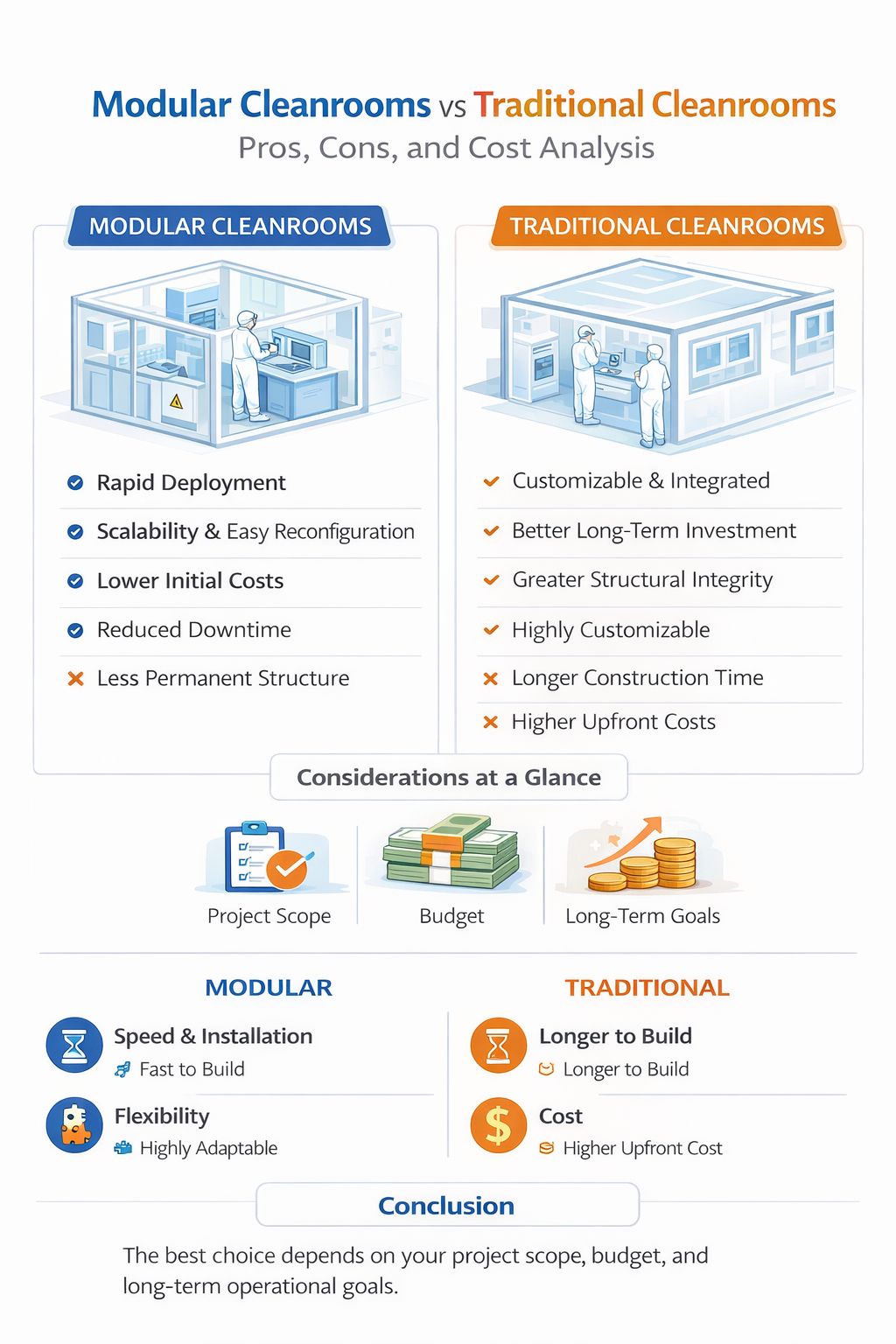
Modular Cleanrooms vs. Traditional Cleanrooms: Pros, Cons, and Cost Analysis
Modular cleanrooms are built from prefabricated components, allowing rapid installation, scalability and easy reconfiguration as needs change. Traditional cleanrooms are constructed in place, offering greater permanence and tighter integration with existing infrastructure, but with longer build times and higher upfront cost. Modular solutions often reach certification faster; the right approach depends on project scope, budget and long-term plans.
Learn more about ASTI’s cleanroom construction services
Cleanroom Airflow Patterns: Unidirectional vs. Non-unidirectional Explained
Unidirectional airflow (also called laminar flow) moves air in a single, uniform direction, minimizing turbulence and sweeping particles away efficiently — ideal for high-grade cleanrooms in pharmaceuticals and microelectronics. Non-unidirectional airflow (turbulent flow) circulates air in multiple directions and suits less critical applications. The airflow pattern chosen directly affects the cleanliness class a cleanroom can achieve.
Learn more about ASTI’s cleanroom construction services
Strict cleaning protocols are essential for GMP compliance in pharmaceutical, biotech and medical device cleanrooms. Effective protocols cover regular surface disinfection, validated cleaning agents, correct gowning procedures and thorough documentation. Consistently applied, they minimise contamination risk, protect product quality and keep the facility audit-ready.
ASTI handles cleanroom validation as part of turnkey cleanroom construction.
Cleanroom Monitoring Systems: Real-time Particle Counting and Environmental Control
Cleanroom monitoring systems provide real-time tracking of airborne particles, temperature, humidity and pressure. By continuously measuring conditions, they help facilities catch deviations early, maintain compliance with ISO 14644 and GMP standards, and protect product quality. Reliable monitoring is a core requirement for pharmaceutical, biotech, electronics and healthcare cleanrooms.
ASTI builds ISO-classified cleanrooms — see our cleanroom construction services.
Cleanroom Construction Materials: Choosing the Right Surfaces for Sterility
Cleanroom surfaces must be smooth, non-porous and resistant to chemicals and microbial growth to maintain sterility and meet ISO and GMP standards. Common materials include stainless steel, epoxy-coated panels and PVC, all chosen because they are easy to clean and resist particle accumulation. Selecting the right materials improves contamination control and extends the cleanroom’s service life.
Learn more about ASTI’s cleanroom construction services
How do you choose a cleanroom contractor in Singapore?
Choosing the right cleanroom contractor depends on a few key factors. Look for proven experience in your specific industry — semiconductor, pharmaceutical, biotech and medtech each have different requirements. Verify the contractor’s ability to handle the full scope, including design, construction, M&E, utility hook-up and validation, rather than relying on multiple sub-contractors. Check certifications, references and the contractor’s track record with ISO 14644 and GMP standards. A capable contractor should also provide post-handover support and understand local regulatory requirements.
Learn more about ASTI’s cleanroom construction services.
What does cleanroom construction cost in Singapore?
Cleanroom construction costs vary widely based on facility size, ISO classification, complexity of utility systems and the industry served. A higher cleanliness class — for example, ISO Class 5 for semiconductor manufacturing — requires more advanced filtration, airflow and validation, all of which add to cost. GMP-compliant pharmaceutical cleanrooms also carry higher fit-out costs due to material and certification requirements. Costs are typically scoped after a site assessment that considers cleanliness class, square metres, utilities, HVAC complexity and validation needs. Engage a contractor early to receive an accurate, project-specific estimate.
Contact ASTI for a project-specific estimate.
How long does a cleanroom construction project take?
Project timelines depend on facility size, cleanliness class, site readiness and the complexity of utility systems being installed. A straightforward fit-out may take a few months, while a large or high-classification cleanroom with extensive M&E and hook-up work can take significantly longer. Validation and ISO 14644 testing add further time at the end of the build. A turnkey contractor like ASTI can compress the timeline by managing design, construction, utilities and validation as a single coordinated project, rather than splitting the work across multiple parties.
Explore ASTI’s turnkey cleanroom services.
What is turnkey cleanroom construction?
Turnkey cleanroom construction means a single contractor takes responsibility for the entire project — design, engineering, construction, M&E, utility hook-up and validation — and delivers a fully operational cleanroom ready for use. This approach gives the client one point of accountability, faster delivery, and tighter coordination between trades. Turnkey is well suited to specialised facilities such as semiconductor, pharmaceutical and biotech cleanrooms, where integrated systems must work together precisely. The alternative is splitting the work between multiple contractors, which increases coordination risk and typically extends project timelines.
Learn more about ASTI’s turnkey cleanroom delivery and M&E and utility hook-up services.
What should I prepare before engaging a cleanroom contractor?
Before engaging a cleanroom contractor, prepare key project information that helps scope the work accurately. This includes the intended use and industry, target ISO cleanliness class, required GMP or regulatory compliance, approximate floor area, and a list of process equipment to be installed. Information about the site — existing utilities, ceiling height, structural conditions and any constraints — also speeds up scoping. The clearer the brief, the more accurate the proposal. A capable contractor will also visit the site and refine the requirements with you during the proposal stage.
Contact ASTI to discuss your project.
What is tool and equipment hook-up in a cleanroom?
Tool and equipment hook-up is the work of connecting manufacturing equipment to the cleanroom’s facility systems so it can operate. This includes connections for ultra-pure water, process cooling water, specialty gases, vacuum, exhaust, drainage and electrical power. In semiconductor fabs and pharmaceutical plants, hook-up is highly specialised — each tool has unique utility requirements, and mistakes can delay production or damage expensive equipment. A skilled hook-up contractor coordinates closely with the tool vendor, facility engineers and trades to deliver clean, validated connections.
Learn more about ASTI’s tool and utility hook-up services.
What is ACMV (Air-Conditioning and Mechanical Ventilation)?
ACMV stands for Air-Conditioning and Mechanical Ventilation. It covers the systems that control temperature, humidity, air movement and ventilation inside a building or facility. In cleanrooms and laboratories, ACMV is critical — it maintains the precise environmental conditions required for contamination control and process stability. ACMV design includes heat load calculations, equipment sizing, duct and pipe sizing, hydraulic calculations and commissioning. Specialised facilities require ACMV designed around their process, not generic comfort cooling.
Explore ASTI’s ACMV and M&E services.
What does M&E engineering cover in a high-tech facility?
M&E (mechanical and electrical) engineering covers the building services that keep a facility operating. Mechanical services include HVAC, ventilation, plumbing and process piping. Electrical services include power distribution, lighting, control panels, backup generators, cable management and safety systems. In cleanroom, laboratory and data centre facilities, M&E must be engineered to higher standards than ordinary buildings — supporting precise environmental control, high reliability and strict compliance requirements. M&E is usually delivered as part of the integrated facility build.
See ASTI’s M&E engineering services.
What is an ultra-pure water (UPW) system?
Ultra-pure water (UPW) is water that has been treated to remove virtually all contaminants — including ions, particles, organics and microbes — to levels far stricter than drinking water. It is critical in semiconductor manufacturing, where even trace contamination can cause wafer defects, and in pharmaceutical production for product purity. A UPW system includes filtration, deionisation, reverse osmosis, ultraviolet treatment and continuous monitoring. The system must be installed, connected and validated to maintain water purity from the treatment plant all the way to each point of use.
Learn about ASTI’s utility hook-up services for UPW and specialty systems.
What are specialty gas systems and why do cleanrooms need them?
Specialty gas systems deliver high-purity gases — such as nitrogen, argon, helium, hydrogen and various process gases — to manufacturing tools in cleanrooms, semiconductor fabs and laboratories. These gases are essential for processes like deposition, etching, annealing and inerting. Because purity and pressure must be maintained from source to point of use, specialty gas systems involve precision-welded piping, leak-tight valves, purifiers, monitoring and safety interlocks. Improperly installed gas systems can cause process failures, safety incidents or contamination, so installation requires specialised expertise.
Explore ASTI’s specialty gas integration and utility hook-up.
What is a BSL (Biosafety Level) laboratory?
A BSL laboratory is a research or testing facility designed to safely handle biological agents according to strict biosafety standards. There are four levels — BSL-1 through BSL-4 — with each higher level adding stricter containment, airflow and personal protection requirements. BSL-3 and BSL-4 labs handle dangerous or exotic pathogens and require highly engineered containment, including controlled airflow, HEPA-filtered exhaust, sealed construction and rigorous access control. Designing and building a BSL lab requires specialist engineering across HVAC, containment systems and safety controls.
Learn about ASTI’s BSL containment laboratory services.
What is a GMP laboratory?
A GMP (Good Manufacturing Practice) laboratory is built and operated to meet regulatory standards for the production and testing of pharmaceuticals, biologics, cosmetics and similar regulated products. GMP labs must control contamination, environmental conditions, materials flow and personnel access to a documented standard. The facility itself — including surfaces, HVAC, utilities and access controls — must be designed for cleanability, traceability and audit readiness. GMP compliance is verified through certification and routine regulatory inspection.
Explore ASTI’s GMP laboratory construction services.
What is the difference between a cleanroom and a laboratory?
A cleanroom is a controlled environment focused on contamination control — managing airborne particles, temperature, humidity and pressure to defined ISO or GMP standards. A laboratory is a facility designed for scientific research, testing or development, which may or may not be a cleanroom. Some laboratories are also cleanrooms (for example, semiconductor R&D labs or sterile pharmaceutical labs), while others prioritise safety containment, chemical handling or specialised equipment instead. Many high-tech facilities combine both — laboratory functions inside a controlled cleanroom environment.
See ASTI’s cleanroom and laboratory construction services.
What is involved in chemical laboratory design and construction?
Chemical laboratories handle hazardous substances and high-temperature processes, so design and construction must prioritise safety, containment and durability. Key elements include chemical-resistant surfaces, fume hoods, dedicated exhaust ventilation, safe storage for hazardous materials, emergency safety systems and high-temperature furnace environments where required. Utility systems — gas, water, electrical — must be engineered for the specific chemicals and processes involved. The lab layout should support safe materials handling and clear separation of high-risk activities.
Learn about ASTI’s chemical and hazardous material laboratory services.
What should I consider when planning a new laboratory?
Planning a new laboratory starts with defining its purpose — the research, testing or production work it will support — and the regulatory standards it must meet (such as GMP, ISO or biosafety levels). Other key considerations include the equipment to be installed and its utility requirements, the chemicals or biological agents handled, required containment, contamination control, layout and workflow, and future scalability. Site conditions like ceiling height, structural loading and available utilities also shape the design. A capable lab contractor will help refine these requirements during the briefing stage.
Contact ASTI to discuss your laboratory project.
What are the cleanroom requirements for semiconductor manufacturing?
Semiconductor manufacturing requires some of the strictest cleanroom standards in industry. Wafer fabrication is highly sensitive to airborne particles — even sub-micron contamination can cause defects and yield loss. Typical semiconductor fabs operate at ISO Class 5 (Class 100) or higher, with unidirectional laminar airflow, HEPA or ULPA filtration, tightly controlled temperature and humidity, and specialised utility systems including ultra-pure water, specialty gases and process exhaust. Sub-fab areas below the cleanroom house chemical, gas and waste systems that support the fab above.
Learn about ASTI’s cleanroom construction for semiconductor facilities.
What are the cleanroom requirements for pharmaceutical manufacturing?
Pharmaceutical cleanrooms must meet Good Manufacturing Practice (GMP) standards in addition to ISO 14644 cleanliness requirements. Cleanliness grades typically range from Grade A (for sterile filling and aseptic processing) down through Grades B, C and D for surrounding support areas. Key requirements include controlled airflow patterns, HEPA filtration, monitored temperature and humidity, surfaces that are easy to clean and disinfect, and documented validation. GMP cleanrooms must also support strict gowning procedures, materials flow and traceability for regulatory audits.
Explore ASTI’s GMP cleanroom and pharmaceutical facility construction.
What are the cleanroom requirements for biotechnology facilities?
Biotechnology cleanrooms support processes such as cell culture, biologics manufacturing and genetic research. They typically combine GMP cleanroom standards with biosafety containment — managing both contamination of the product and containment of biological agents. Cleanrooms often run at Grade B or C with localised Grade A zones for critical operations. Engineering considerations include HEPA-filtered air supply and exhaust, controlled pressure cascades, sealed construction for containment, dedicated airlocks, and utility systems for purified water and specialty gases. Materials and surfaces must support cleanability and disinfection.
Learn about ASTI’s biotech cleanroom and laboratory services.
What are the cleanroom requirements for medical device (medtech) manufacturing?
Medical device manufacturing cleanrooms must control contamination to protect both product quality and patient safety. Requirements vary by device class — sterile or implantable devices need higher cleanliness levels than general devices. Typical medtech cleanrooms operate at ISO Class 7 or 8, with HEPA filtration, controlled temperature and humidity, ESD control where required, and surfaces designed for cleaning and disinfection. Facilities must support traceability, materials flow and compliance with regulatory standards such as ISO 13485. Validation and certification are essential.
Explore ASTI’s medical device cleanroom construction.
What are the cleanroom requirements for aerospace and high-tech manufacturing?
Aerospace and advanced high-tech manufacturing — including precision optics, satellites, sensors and specialised electronics — require contamination control to protect sensitive components during assembly and testing. Cleanroom classes typically range from ISO Class 6 to ISO Class 8 depending on the component, with HEPA filtration, controlled airflow, ESD protection and stable temperature and humidity. Some processes require dedicated zones for activities such as bonding, coating or vacuum testing. The cleanroom must be engineered around the specific manufacturing process and quality requirements.
Learn about ASTI’s cleanroom construction for high-tech manufacturing.
